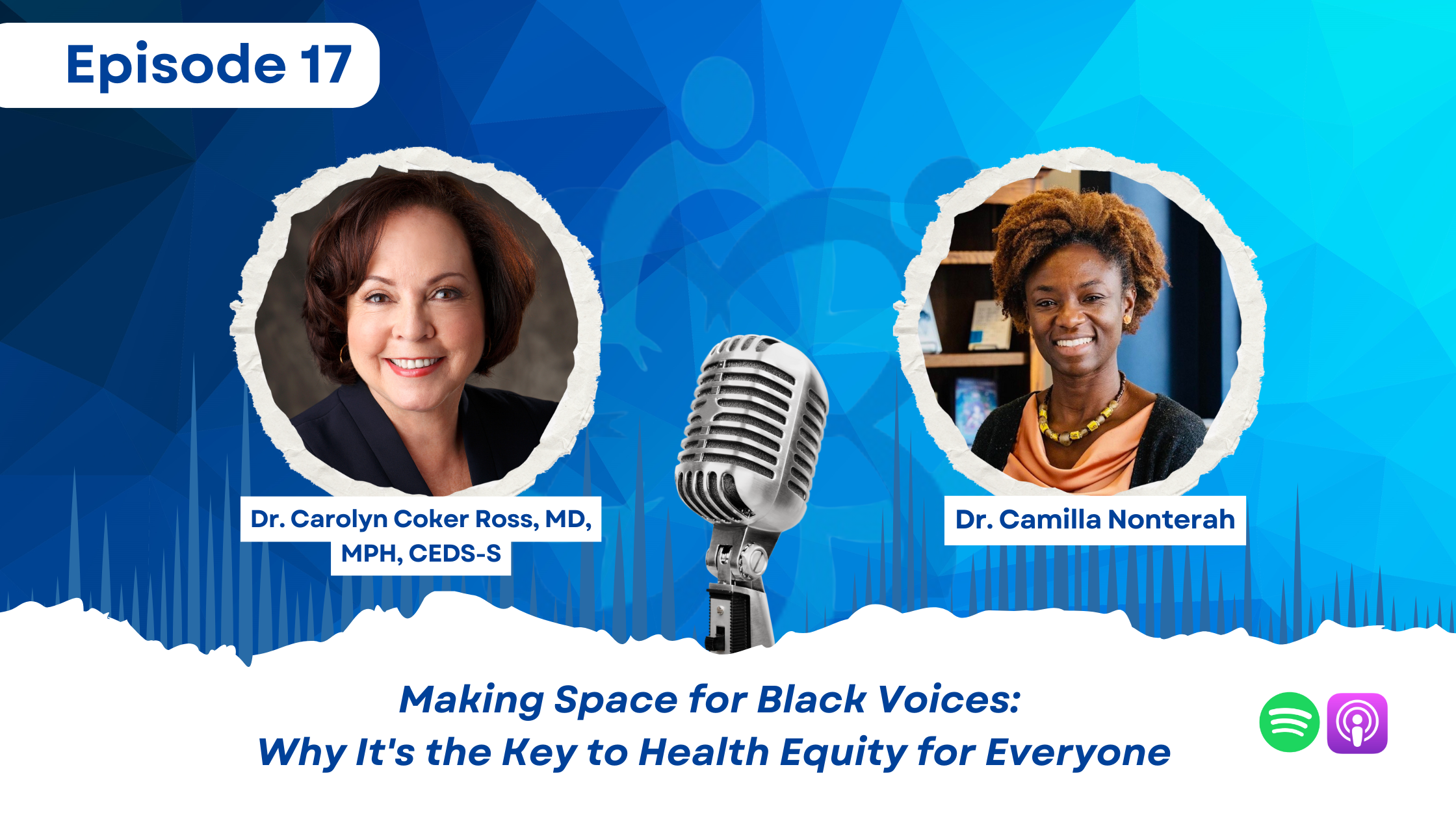
I am so thrilled to share this incredible conversation with Dr. Camilla Nonterah where we truly dig into her chapter, “Making Space When Black Voices Speak Their Truth.” If you’ve ever felt confused or frustrated by conversations around race and justice, this episode is for you. We break down the complex issues using simple, clear examples that will change how you view everything—from scientific research to your own workplace!
We discuss the shocking reality of Black maternal health outcomes. We clarify that the problem isn’t biology; it’s the institutional failures that we must address to achieve health equity.
Guest Links:
@drcnonterah on Instagram; @drcnonterah.bsky.social
Dr Carolyn’s Links
Linkedin: https://www.
TEDxPleasantGrove talk: https://youtu.be/
To buy “Antiblackness and the Stories of Authentic Allies” – bit.ly/3ZuSp1T
About our guest:
Dr. Nonterah is an associate professor of psychology at the University of Richmond and director of the EQUITY Research Lab. She also holds an affiliate position as an assistant clinical professor of psychiatry at Virginia Commonwealth University School of Medicine.
She is a counseling psychologist whose research and clinical interests focus on behavioral medicine. Her research focuses primarily on physical and mental health in underserved groups and minoritized populations and is guided by a multicultural and intersectional framework.
Most of her work focuses on the psychosocial aspects of end-stage organ disease and solid organ transplantation by examining health inequities, treatment seeking, and mental health in this area. She is also interested in cultural influences on mental and physical health and positive psychology. She has published several peer-reviewed articles and has been invited to speak on many of these topics, with a significant focus on health inequities faced by Black kidney patients seeking access to transplantation.
Dr. Carolyn Coker Ross: Hi, this is Dr. Carolyn Coker Ross, bringing you the Inclusive Minds Podcast. This podcast was inspired by the book of which I’m a co-editor entitled Anti-Blackness and the Stories of Authentic Allies. Lived experiences in the fight against institutionalized racism. If you’re a psychologist, a social worker, an addiction professional, or a healthcare provider, or anyone who wants to broaden your horizons, then this podcast is for you.
The goal of the podcast is to help you understand some of the more complex issues facing our culture today. My guests Are experts in their fields, and we’ll be talking about a wide array of topics including cross-cultural issues, the intersection of race and trauma, social justice and health inequities.
They will be sharing both their lived experiences and their expert opinions. The goal is to give you a felt experience and to let you know that you are not alone in being confused by these complex. Issues. We want to provide nuanced information with context that will enable you to make your own decisions about these important topics.
Hi everyone and welcome to Inclusive Minds Podcast. Today my my guest is, uh, Dr. Camilla Nonterah, and she’s gonna be talking with us about the chapter that she wrote for. The book that I’m a co-editor of Anti-Blackness and the stories of Authentic Allies lived experiences in the fight against institutionalized racism.
Welcome to the show, Dr. Nonterah.
Camilla Nonterah: Well, thank you very much, Dr. Ross, for the invitation to talk about my chapter.
Dr. Carolyn Coker Ross: Well, let me tell everybody a little bit about you. Dr. Nonterah is a, an associate professor of psychology at the University of Richmond and director of the Equity Research Lab with an affiliate role at Virginia Commonwealth University School of Medicine, a counseling psychologist specializing in behavioral medicine.
Her work centers on physical and mental health among underserved and minoritized populations. Through a multicultural intersectional lens. Her research primarily examines psychosocial factors, health inequities and mental health in end stage organ disease and transplantation with a particular focus on the experiences of black kidney patients.
She has published widely and is a frequent speaker on health equity and cultural influences on wellbeing. Sounds like you have an interesting career.
Camilla Nonterah: Yeah, thanks.
Dr. Carolyn Coker Ross: So your chapter in the book was Making Space when Black Voices Speak their Truth. And in your chapter you talk about, firstly about social determinants of health.
Can you just give a quick like overview of that for our listeners who may not be familiar with it?
Camilla Nonterah: Yeah. Um, so social determinants of health, we like to think of them as where you live, um, the conditions in which you live. It could be where you go to school, where you worship. All of those have an influence on your health outcomes.
Um, you know, a lot of us do not choose those things. And so, you know, for example, if you grow up, if you are born into a family that is lower income and has, low resources, that is going to influence your access to certain types of foods, it’s going to influence your access to the best forms of education, and that in itself can determine your health outcomes.
Dr. Carolyn Coker Ross: Okay, great, thank you. In your chapter you say, much of the psychological literature and theories established over multiple decades are saturated with western, educated, industrialized rich, democratic samples. Or the acronym is WEIRD, that center individualism, even though people of color make up the global majority, what’s the significance of that statement?
What does it mean WEIRD people are the center?
Camilla Nonterah: Yeah. So, um, a lot of our research is very much, you know, the people who are participating in research, especially in the field of psychology, but also in other, a lot of other fields a lot of them fall under this criteria, right?
Dr. Carolyn Coker Ross: So they tend to be western, educated, rich, democratic, and male and
Camilla Nonterah: yes, yes, yes, indeed, indeed.
Um, and, and male. And so when we are sampling this specific group of people and then we’re generalizing to everyone. Um, that creates a problem because it reduces your ability to really understand the experiences of people who fall outside that category. So even if we think about people who are Western, who are not democratic or who are not educated, we don’t even get to have Get to the core of their experiences because they don’t fall under this category. From the standpoint of looking at the experiences of people, of the global majority, they don’t, A lot of them may not fall under this category too as well, so we’re missing the nuances in their experiences we’re missing, for example.
The fact that collectivism or collective this values may be important to them. And so if we have our findings that say, you know, you know, we come to these conclusions, we may not be getting the core of the picture.
Dr. Carolyn Coker Ross: Yeah. And I think a good example is how a lot of research, even in women’s health has been done on men, not women.
And within that even has been done on white women, not black women or other women of color. And so then when you generalize those experiences, as you say, they may not really. Have the same results. So thanks for illuminating that for us. So another, uh, I love this, this, uh, this quote from your chapter.
It’s just so it’s perfect. You say in the chapter, our current practice of science is analogous to cooking in which one prepares the main meal. Everything Eurocentric. And then after that, add spices. In other words, the experiences of people of color for additional flavor. Can you say a little bit more about what it means to center marginalized voices rather than weird or Eurocentric voices?
Camilla Nonterah: Yeah. So, you know, I, I use that, that analogy to hopefully help people understand what we mean by centering the experiences of you know, people of color or people who are, do not make the majority in any sense, whether it’s power, but also in numbers. It’s because If you think about making a stew, right, and you make the whole stew and you add a little bit of spice, you could potentially do without that spice, right?
That spice is almost seen as like, maybe it enhances your flavor a little bit, but then it, it’s not an integral part of your stew. And so. In the same way when we create research. So if I have a research question, and a lot of my questions are based on the experiences, for example, of middle class white women, I do not understand what it, how it might look different.
Um, so Dr. Ross, you gave the example of, um. And then, you know, especially in the medical field, we do see a lot of outcomes for women’s health not being, being different because, you know, traditionally we focus a lot of research on the experiences in men. And so the, it’s the same thing when we look at maternal health.
For example, we see that even though maternal health, when we compare outcomes in the US to other western countries, you know, we’re doing well. But when we compare outcomes for black women specifically, the rates are much lower and actually marial. Outcomes for people from developing countries. Right.
Dr. Carolyn Coker Ross: So if, but our, even our outcomes for, you know, white women are much lower than other Western countries.Which is shocking, you know? Given how much money we spend on, you know, on healthcare in this country.
Camilla Nonterah: Mm-hmm. Yeah. Yeah. And so being able to have a better sense of why that is, is being able to get to the core of the experiences of people.
Um, and so, you know, in, in the case of. Trying to understand why we have these varying outcomes. You know, we know that from a biological standpoint, race is, is not a biological construct, right? It’s a social construct or social political construct.
Dr. Carolyn Coker Ross: It’s just made up basically. Yeah.
Camilla Nonterah: Yes. Um, and because, you know, it changes, you could go from one country to another. So how you might identify in, um, the US it will look different from, uh, how you would identify in South Africa or maybe in Brazil, right? So that lets us know that it’s not, that’s just an example of why it’s not a biological construct.
Dr. Carolyn Coker Ross: But the, the deepest example is on the DNA level. We’re all 99.9. Percent the same. So, you know, that’s the most compelling evidence that it’s not a biologic.
Camilla Nonterah: Exactly. Exactly. Exactly. So, you know, when, when we think about the experiences of, you know, using that example of maternal health. Why are black women having, you know, much lower outcomes relative to white women.
Um, and so we have to think about things, social determinants of health. What is in the environment, what is in the, their experiences with a healthcare system. So doing quality research. would be centering on their experiences, centering on, you know, collecting a sample that’s heavily focused on the, on, on black women, black maternal health, trying to get, not just, you know, these, like whether it’s physiological measures, but also trying to look at things in the environment, things in the social environment that may be influenced in these poor outcomes,
Dr. Carolyn Coker Ross: Whether it be nutrition or education or access to care, et cetera.
So, but I can just. Here, the pushback on that. So if you center experiences of women of color, aren’t you leaving leaving out the experiences of white women? Wouldn’t that be the same? Thing. What, what, what’s the advantage really, because there really is an advantage to centering, uh, the experiences of people of color, especially in the maternity arena.
What is the advantage of doing that?
Camilla Nonterah: Well, uh, the many advantages and you can think of, for example, if, if you care about health outcomes and you care about having, um, a healthy population. You want to be able to take of people who have. The poorest health outcomes because a lot of the time if you have, you take care of those people, you’re gonna take care of everyone.
Dr. Carolyn Coker Ross: Exactly. And I think that’s an a really important point. If you design a system that takes care of people who are doing the worst, then of course that same design will affect even people who are doing the best even more. And I think that’s what I think a lot of people don’t understand. They feel like it’s either, oh, either we’re in front or they’re in front.
So, uh, one of my colleagues made an example about, you know, the disability movement had changed. Yeah. How would it change the curbs? Yes. You know, when you get to the, a corner, they, they have, I forget what you call ’em now, but you know, you have the curbs that are flattened out so that someone in a wheelchair, for example, could, well, he was saying.
He never thought about it until he had kids, and now it helps him because he’s pushing a stroller. And it’s a lot easier. Or you know, for myself, I had knee surgery, it was a lot easier to walk down those curbs with the cane or a little push, you know, walker than it was before. The disability movement helped us with that arena.
So that’s a great example of how everyone has benefited, even though those curbs were designed for people in, for example, with disabilities who are differently abled. So, yeah.
Camilla Nonterah: Yeah, exactly. Exactly. That’s, that’s a great example. And one, I had not heard off two until, I know, I thought it was a great example too.
Dr. Carolyn Coker Ross: I was like, oh my goodness. I, I forgot to ask him, where did you get that? But, but anyway, he has three. Kids, I think under the age of five. So you can imagine, yeah, he’s struggling with a lot of transportation issues, especially living in New York where I’m sure he has to get kids on and off, subways and walk a lot and all that stuff.
So let’s move on to talking a little bit more about the What you mentioned in the title of your chapter, which is Making Spaces When Black Voices Speak Their Truth. So why is it necessary to cultivate spaces in which Black Voices can be heard?
Camilla Nonterah: I think in general the expanse of a lot of black individuals is that they do not always have spaces that represent ’em, spaces that affirm them.
You know, you, you can think of it in little things such as you walking into an office. And the pictures representative of you, are the pictures representative of your culture? Are they representative of things that you grew up with? And so that’s a simple example, but it makes a huge difference when you walk into a room and you’re like, oh, I’m seen and I’m part of this Sspace and the something that’s welcoming about this space. So those things are really important because it allows black people to have their experiences seen from their vantage point rather than being seen as a disadvantage. So when you are comparing somebody you know, and, and even like you use the example of.
You and I, Dr. Ross. So if I am trying to compare myself to you, so you have, for example, a medical background, right? And I’m a psychologist and I’m trying to compare, or somebody’s comparing us. And comparing our knowledge and comparing some of our experiences, that puts me at a disadvantage already because we did not have the same experiences.
We did not have the same type of knowledge. So if you’re talking about certain like medical terms, I’m just not gonna know it.
Dr. Carolyn Coker Ross: But if you put me in a psychology. Room full of psychologists, then I’m at a disadvantage.
Camilla Nonterah: Exactly. Exactly. Yeah, exactly. So you can think of it in that way, right? So black people do not make the majority in, in this country.
Um, and so when they’re in. Spaces, especially in predominantly white spaces, a lot of things that are affirm that could affirm them may be missing. And so that does not allow them to be seen from the vantage point, but also it does not allow them to also experience, you know, the comfort of just being in a space where you know, that your experiences are valid or seen and valued by others.
Dr. Carolyn Coker Ross: Yeah, I think that’s really important. I mean I was one of a handful of black medical students at the University of Michigan and they to be fair, they’ve been over backwards to try to make us feel at home in the best ways they could. Like we had our own advisor who was an African American man who had been at the university for many years.
We met as black students together to discuss our challenges and so on, but in every other, every other day where, where those things weren’t happening in every space in the medical schools. I was one of a few who were in the classroom, in the lab, in the anatomy suites, et cetera. And it was, I think having grown up, you know, during the end of Jim Crow and, you know, going to school in all segregated schools, living in a black community growing up and so on, it was definitely difficult to feel like I could speak up or not show up as being perfect. Or the smartest one in the room or whatever to, to prove myself. So I’m sure, especially as younger people come up being able to feel, as you say, validated or seen or heard is really important. Why is that so complicated to use Black voices? Why is it complicated?
Camilla Nonterah: So, you know, in, in, in the chapter I talk about a number of things that complicated.
so we do know that there are a lot of stereotypes associated with black people. So whether it’s a stereotype of being angry or the stereotype of being lazy or, you know, and I think you can speak to most people in the US and they are aware of some stereotype associated with black individuals.
And so it makes it really complex to. Use your voice, especially when there’s something happening that does not feel right, feels unjust, because there are all these fears about what could come up. You might say.
Dr. Carolyn Coker Ross: Do you mind telling the example of Sharon Osborne that you talk about?
Camilla Nonterah: Yeah. Um, yes. Um, so I, I gave, I use that example and a lot of of viewers are probably aware of that.
Um, so. This happened when there was some, I think it was Pierce, uh, I, I, I keep forgetting his name. Pierce Pierce.
Dr. Carolyn Coker Ross: Morgan. Morgan, yes. I, I wanna call him the British something else.
Camilla Nonterah: The British, the British, uh, talk show guy. Yeah. Pierce Morgan. Pierce Morgan. Um, so he was criticizing Meghan Markle had said some things and on the, so it was on the talk.
Um, and you. Yes. Um, so I believe it was in 2020. There have been this, you know,
Dr. Carolyn Coker Ross: I have your chapter right here. Do you want me just to read that for you?
Camilla Nonterah: Uh, sure. If, if it, if that’s easier.
Dr. Carolyn Coker Ross: Well, I’ll just read the exam. The, uh, situation. Okay. So there, there was an encounter between Cheryl Underwood who is.
African American, right? Yes. Mm-hmm. And then Sharon Osborne, who we all know on the television show the Talk in March of 2021, and Osborne became defensive as she challenged the notion that her friend Pi Morgan was racist based on his comment about Meghan Markle. So you can take it from there if you want.
Camilla Nonterah: Yes. Yes. And um, and so during that exchange, Osborne reprimanded Underwood telling her not to cry and that she should be the one crying, um, and demanded that Cheryl. Educate her about racism. And so during that encounter it was, you know, it was a very, so I do not watch that show a lot, but I remember watching clips of it.
And so during that encounter it was very uncomfortable. And, um, during the whole time, so there was another host. Who identifies as, um, black or African American as well. And they both remained calm, even though Osbourne was the one who was like, you know, kind of demanding something, demanding a response from them.
And, you know, and, and also being demanding in the sense that she was asking them to teach her, you know, to tell me if I’m wrong. So. I use that example in the chapter because my hope is that a lot of people like me have seen that clip and so they can, it can be some form of a mental picture of what they experienced.
Maybe like for a black woman. Who in that case in many ways, Cheryl could have responded and been being upset and said you don’t get to demand that I teach you right now about racism. But instead she was very calm. And seem as if she was using a lot of regulation just to stay calm within that moment.
The reason why I use this example is to get to a stereotype that a lot of us are aware of as the angry black woman and so that’s a big fear of a lot of black women because it emotions that me. You know, may not be, have anything to be do with anger or associated with that stereotype, so some black women will give some examples of, oh, they’re just having like a day where they’re not.
Smiling and people are like, oh, you’re angry. And it’s like, um, this is just my face.
Dr. Carolyn Coker Ross: Yeah. Or I’m just thinking of other things, you know?
Camilla Nonterah: Exactly. Exactly. And so, you know, with a white woman, for example, who has the same facial expression, there isn’t that stereotype associated with her. Or she may be even allowed to be angry without that stereotype associated with her.
Dr. Carolyn Coker Ross: Um, and so for also, they felt that, I mean, or it looked like they were kind of protecting of her because they didn’t respond in a way that maybe a another white woman had would’ve responded. They didn’t lash back. They didn’t meet her level of, you know, anger or upset or whatever.
And there’s that sense that, as you know, as people of color, we have to protect the feelings of, you know, particularly white women. You know, there’s that trope about white women’s tears. I, I think it’s called.
Camilla Nonterah: Yes. Yes. And yeah. So there, there are a lot of things going on in that dynamic and it’s even though it’s a, a small clip, it is just an example of why it can be really hard to use a person’s black voice.
because there’s so many layers attached to you and your using your voice in a way that another person doesn’t have to worry about those things. Okay. Yeah.
Dr. Carolyn Coker Ross: What does it mean to weaponize black courage, which was another concept you talked about in your chapter.
Camilla Nonterah: So, weaponizing black courage is, um, also thinking about, so you can think about it in the sense, first of all, it’s complicated to use your voice.
Mm-hmm. And then when you do use your voice, it could be consequences. Even when you are speaking the truth, even when you are, you know, talking about something that’s unjust that could be consequences. And so that’s what I mean when I use the term weaponizing, that’s what I’m referring to and the consequences may seem, some of them may be big, some of them that may be smaller.
Whatever the case, there are consequences.
Dr. Carolyn Coker Ross: Like you could lose your job. That’s one, yeah. Mm-hmm. Consequence. you could be reported. Yeah. Saying something that somebody misinterprets or feels you, you don’t have the right to say what are some of the other consequences you’ve seen.
Camilla Nonterah: Yeah. Um, and, and something small as you could lose a friendship, right?
which is it, it might seem small, but you know, relationships mean a lot to a lot of us, right? So saying something, so if your friend is doing something that is unjust and having the courage to stand up to them, that may be threatening of your, your friendship. It may be threatening of your relationship.
And then there may be times where. There doesn’t seem like there’s this apin consequence, but you know, the maybe instances in which, for example, if you have a supervisor, they’re almost like taking notes of some of the things you’re saying and subconsciously they may not even be doing it consciously, subconsciously, they may be.
Starting to use certain labels on you. So maybe this is a difficult, person or they seem to interrupt the space a lot and so that in itself could, for example, influence your review and you may not get as positive of a review. So maybe you may not get fired, but you may not get a positive review, which influences your money because you, that may influence your ability to get a promotion.
Or to get a raise.
Dr. Carolyn Coker Ross: Yeah. Okay. Good. Well, so tell us what, what are some ways to create spaces for Black Voices? Have you seen that happen in universities or in other settings? Uh, where you have any examples of that?
Camilla Nonterah: Yeah. so I think in creating spaces, um, it’s very important to first of all have some form of education about the fact that what we’ve talked about already in the sense that it, there there is courage needed for people to use their black, black voice.
you know, the history of this country and black people are Susceptible to racism, different forms of racism, you know? So I think when a lot of us think of racism, we think of the blatant racism, right? So somebody you know, maybe crossing the road because they see a black man walking or somebody saying like, I don’t wanna sit next to you.
I don’t wanna touch your hand. Um, or I don’t want to give you certain services because you’re black.
Dr. Carolyn Coker Ross: Yeah. If I’m a black doctor, a patient coming and saying, I, I don’t wanna see a black doctor.
Camilla Nonterah: Yeah, exactly. Exactly. Exactly. Um, but there’s so many other forms of racism and obviously we, we don’t have time to go through the various forms,
Dr. Carolyn Coker Ross: but they’re a monumental number of various forms.
Camilla Nonterah: Yes, yes, yes, yes. So being aware of that. So things such as, you know, a lot of people may have, some people may have heard the term microaggressions. Mm-hmm. Right. So these are little slights, that kind of it you can think of as, as a cutting.
Cut somebody a little bit at a time. Right? Yeah.
Dr. Carolyn Coker Ross: Like a paper cut.
Camilla Nonterah:Yeah, exactly. But it still hurts. It still hurts. And if you get multiple paper cuts, it’s gonna hurt real bad.
Dr. Carolyn Coker Ross: You could bleed to death. Yeah.
Camilla Nonterah: Um, and so I think being aware of that is kind of a starting point. Also, you know, things such as advocating for. Proper compensation, um, in the work field. Um, because again, we do see a lot of, um, disparities in pay. Um, between black employees and white employees. And especially we can see it among black women sometimes.
Um, and so if you are somebody who’s really held, you know, bent on creating an atmosphere in which people have a space that feel, affirm, affirm an individual for the work they’re doing, right? Make sure that you’re compensating them accurately. Make sure that when you are in a space you know, especially when there’s just one black person who’s talking about their experiences, it’s important that we, we listen and we listen to hear and not to respond.
’cause a lot of us are naturally listen because we wanna create a response quickly. But if you are truly invested in elevating black voices, you listen carefully and you. Engage in active listening so that you’re better able to understand their experiences also trust that they know their experiences better than you.
Dr. Carolyn Coker Ross: Okay? You have to give an example that
Camilla Nonterah: well, um, you know, for example, if, um, so I think about. The experience of maybe being like a black student and going to, um, like a faculty member and saying, oh, you know, this, I had this experience, whether it was with like an internship or whatever, where. This person was behaving in this way towards me.
you know, it was really uncomfortable. So maybe they experienced a microaggression not dismissing it. Right. So not saying, oh, you know, they’re fine.
Dr. Carolyn Coker Ross: Oh, they didn’t mean that. They didn’t mean that. Are you sure you didn’t misinterpret that?
Camilla Nonterah: Exactly.
Dr. Carolyn Coker Ross: Maybe you’re being too sensitive.
Camilla Nonterah: Exactly. Yeah. Okay.
Dr. Carolyn Coker Ross: So those are the things that. Black women, black and men face when they share their experience. That they’re told, oh, that’s not really what happened. You know?
Camilla Nonterah: Very much so. And you know, and that’s shutting somebody down. Right. Um, because then they’re not gonna come to tell you because you’re, you’re basically diminishing their experience when, especially when you don’t have that experience.
Dr. Carolyn Coker Ross: Yeah. When your experience is what it is, it’s true for you. Yeah. So we, you know, we’re living in challenging times. How do you think these challenging times have affected the ability for black people to speak their truth and the space for black people to speak their truth?
Camilla Nonterah: I think. Putting on my researcher hat, right?
So I haven’t done any research studies, but I can imagine that it has had a tremendous impact in ways that are not even apparent to me. For example, just the idea that we have certain words that have become taboo now. words that used to be a way of us getting closer to a space where people can feel affirmed in their experiences and also reduce some of the differences that we see that are unequal.
Dr. Carolyn Coker Ross: So you’re talking about like DEI? Yes. Yeah. You know, taboo. Yeah. Yeah. Not just the words, but actual the practice of DEI.
Camilla Nonterah: Exactly. Exactly. You know, so a lot of this has become taboo now and what. People fail to realize especially going back to DEI is DEI helps everybody. So going back to what we had talked about before about the curbs, you know?
That’s all part of DEI. Thinking about the fact that, you know, even being a mother and having a nursing station that is DEI.
Dr. Carolyn Coker Ross: Yeah. Right. Yeah.
Camilla Nonterah: And I think people don’t think about that be because, you know, they may be focused on, oh, you know, we’re focusing on a specific group, and is that excluding the rest of the people who do not fall within that group, but they don’t see how it actually helps.
All of us. So you know, so all of these things have made it harder for black individuals to be able to voice their complaints to voice their experiences to talk about the ways in which the maybe inherent injustices and systems and, you know, I, I think. Years from now.
I mean, who knows, maybe a decade from now or more we will have a sense of how deeply it has impacted us and impacted everyone for that. Yes. For that matter.
Dr. Carolyn Coker Ross: Right. Thank you for that. Well, it’s been a pleasure talking to you and I really enjoyed your chapter and I hope other people will get the book and, and read more about.
This topic of, of creating spaces for Black voices. It’s a wonderful topic and I really, uh, have, have enjoyed speaking with you today. So thanks for being on The Inclusive Mind Podcast.
Camilla Nonterah: Thank you very much Dr. Ross, with the invitation.
Dr. Carolyn Coker Ross: You are very welcome. Thanks for listening. Please subscribe to the Inclusive Minds Podcast so we can let you know when the next great guest comes on.
The link to subscribe is in the caption below.