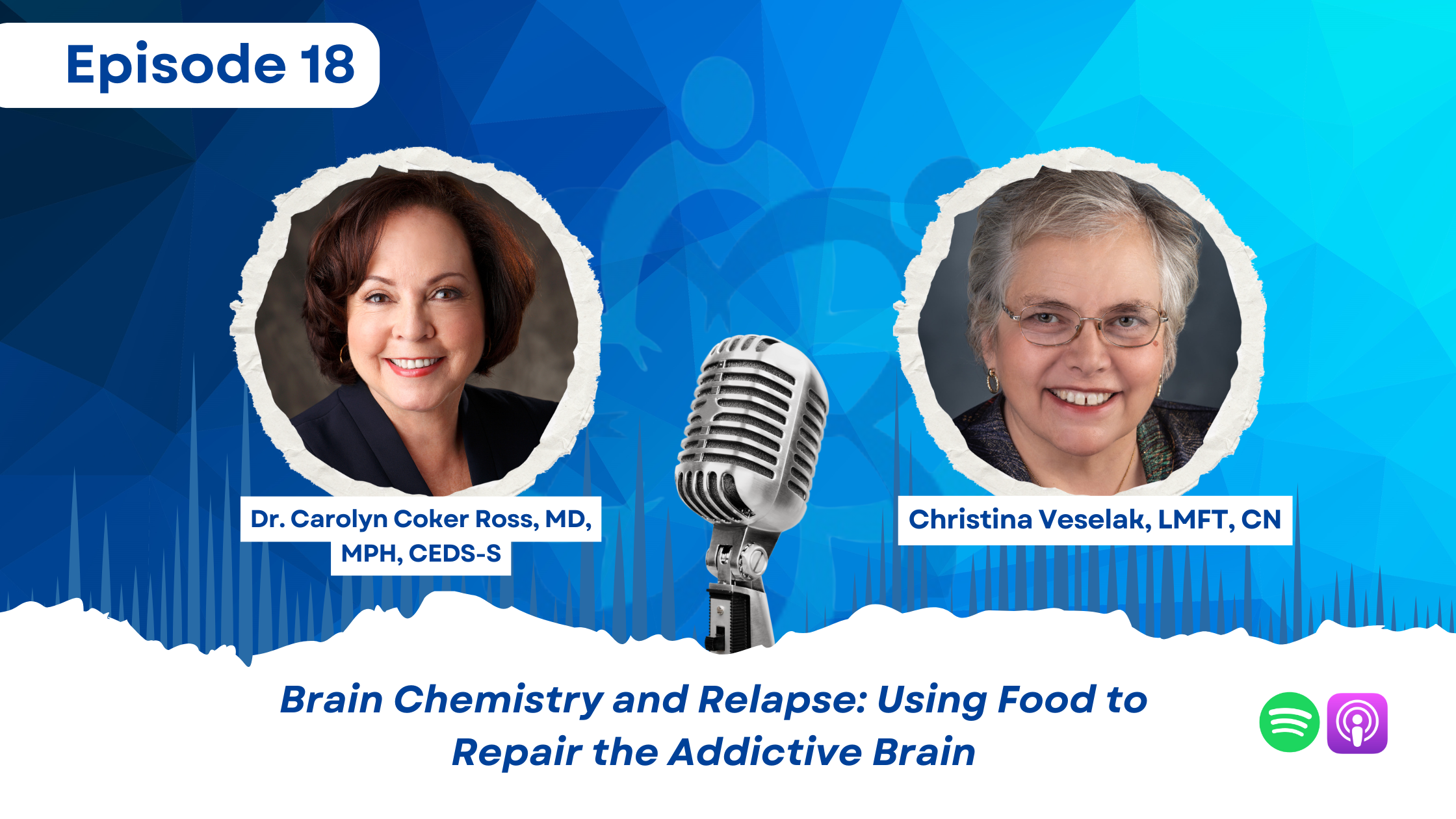
Are you or a loved one struggling with chronic relapse, persistent cravings, or anxiety in recovery? This episode is a game-changer. Dr. Carolyn Coker Ross welcomes her longtime friend and expert, Christina Veselak, to dive deep into the often-overlooked biochemical roots of addiction and mental health struggles. Learn how simply changing what and when you eat can eliminate cravings in minutes and dramatically improve long-term sobriety.
- The “Starving Brain” Theory: Christina explains how years of poor nutrition or substance use depletes the brain’s necessary neurotransmitters, leading to debilitating cravings, anxiety, depression, and fatigue.
- Amino Acids as a Game Changer: Discover how targeted amino acid supplementation can rebuild a depleted brain and stop cravings within 20 minutes—a highly effective, non-addictive solution.
- The Five-Star Pro Recovery Diet: Christina breaks down her easy-to-follow food philosophy focused on stabilizing blood sugar and maximizing nutrient intake. The key elements are Protein (20g every 4 hours), Healthy Fats, Complex Carbohydrates, Personalization, and Clean Eating.
Guest Bio:
Christina T. Veselak, LMFT, CN, is the founder and director of the Academy for Addiction and Mental Health Nutrition. A licensed psychotherapist for over 30 years, she provides online Relapse Prevention Coaching and Mental Health Nutrition support, consulting with supplement companies, IV detox programs, and residential treatment centers to integrate nutritional approaches to recovery.
She is also the founder and CEO of Eating Protein Saves Lives! and bestselling author of EAT! A Guide to Radiant Recovery Using Food and Amino Acids to Repair the Addicted Brain and Reduce Cravings. A seasoned national speaker and founding member of the Alliance for Addiction Solutions, Christina continues to advance evidence-based nutritional and biochemical strategies for brain and mental health.
“I’m dedicated to saving and transforming lives through amino acid and nutrient therapy.”
Dr Carolyn’s Links
Linkedin: https://www.linkedin.com/in/carolyn-coker-ross-md-mph-ceds-c-7b81176/
TEDxPleasantGrove talk: https://youtu.be/ljdFLCc3RtM
To buy “Antiblackness and the Stories of Authentic Allies” – bit.ly/3ZuSp1T
Dr. Carolyn Coker Ross: Hi, this is Dr. Carolyn Coker Ross, bringing you the Inclusive Minds Podcast. This podcast was inspired by the book of which I’m a co-editor entitled Anti-Blackness and the Stories of Authentic Allies. Lived experiences in the fight against institutionalized racism. If you’re a psychologist, a social worker, an addiction professional, or a healthcare provider, or anyone who wants to broaden your horizons, then this podcast is for you.
The goal of the podcast is to help you understand some of the more complex issues facing our culture today. My guest. Are experts in their fields, and we’ll be talking about a wide array of topics including cross-cultural issues, the intersection of race and trauma, social justice and health inequities.
They will be sharing both their lived experiences and their expert opinions. The goal is to give you a felt experience and to let you know that you are not alone in being confused by these complex. Issues. We want to provide nuanced information with context that will enable you to make your own decisions about these important topics.
Hi everyone. This is Dr. Carolyn Coker Ross and welcome to Inclusive Minds Podcast. Podcast. Today I have a very special guest who’s actually a long. Term. Friend of mine from my Denver era, I’ll call it, her name is Christina Veselak, and Christina is the founder and director of the Academy for Addiction and Mental Health Nutrition.
She’s a licensed psychotherapist for over 30 years. She provides online relapse prevention, coaching and mental health nutrition support consulting with supplement companies, IV detox programs, and. Residential treatment centers to integrate nutritional approaches to recovery. She’s also the founder and CEO of Eating Protein Saves Lives.
That’s a good title. And she’s the bestselling author of EAT A Guide to Radiant Recovery, using Food and Amino Acids to Repair the Addictive Brain. And reduce cravings. She’s a seasoned national speaker and founding member of the Alliance for Addiction Solutions, and she continues to advance evidence-based nutritional and biochemical strategies for brain and mental health.
And her quote is, I’m dedicated to saving and transforming lives through amino acid and nutrient therapy. Welcome to the show, my bud, Christina.
Christina Veselak: Great. Thank you Carolyn. Thank you so much for having me, and it’s lovely seeing you again after all these years.
Dr. Carolyn Coker Ross: Yeah, we, we worked together in Denver and I think you were the first one who introduced me to the concept of using amino acids intravenously for detox.
And we’ve talked a lot about that. Just to start, I’d love to know a little bit about your quote unquote origin story. So how did you get started in using nutrition therapies in addiction treatment?
Christina Veselak: Well, I’ve been a therapist for about 10 years working in and around the addiction field, and I got introduced to the concept of using amino acids for addiction, and this fascinated me because I’d always been interested in nutrition and that there were actually substances that you could get over the counter. That would turn off cravings within 20 minutes was mind blowing. And so I started meeting with the head of one of the amino acid distribution companies in the country and met with him every Friday for lunch and got myself well-trained.
Then met with other nutritional treatment providers around the country and kept getting trained. Became a certified nutritionist in 1993, and then I started studying functional nutrition with Dr. Jeffrey Bland before the term was even coined. And you know Carolyn, as I tell people, when I sat in on his seminars, ’cause he was teaching high level nutrition at first, 75% of it was going over my head.
Dr. Carolyn Coker Ross: It’s mostly biochemistry that he talks about. Really,
Christina Veselak: it’s all biochemistry. And I had never taken a biochemistry class in my entire life. Yeah, but I just hung in there. I hung in there, and then 50% went over my head and then 25%, and now I’m teaching it. Now I’m not teaching it at that level. I’m teaching it at this level where therapist level.
Dr. Carolyn Coker Ross: Yeah, it’s more accessible to all of us instead of just Dr. Bland. So he’s, he’s an amazing guy. I agree. he’s, so I wanted to find out a little bit about your book, eat A Guide to Recovery. Do you have a copy there to show us the picture? Okay. So when did your book come out? It got published in April of this year.
Wonderful. And tell me a little bit about it.
Christina Veselak: Well. It’s actually, as you see from the, from the picture cover, it’s pretty Right.
Dr. Carolyn Coker Ross: Very pretty.
Christina Veselak: And so it has, we have pictures all the way through. Lovely. To make it accessible. Yeah. To the person in early recovery. To recovery high schools to,
Dr. Carolyn Coker Ross: so this is all about, this is all about nutrition for recco recovery from substance use disorders.
Christina Veselak: It really is. And you know, it comes out of the time where you and I actually met, you know, when I lived in Denver and I had a practice for 20 years in Denver specializing in the person with chronic relapse. I had all my colleagues in Denver. I asked, send me your treatment failures.
Send me the person who’s going to three meetings a day, has gone to five treatment programs, is dedicated and committed, and still can’t make it.
Dr. Carolyn Coker Ross: And when did you learn from seeing That’s a, a wonderful way to learn. ’cause I always say I’ve learned more from my patients than I ever did in medical school.
Christina Veselak: Well, I learned a tremendous amount, and this book is actually the ultimate result of what I learned, which is that for, you know, everybody had their own story. Everybody had their own struggles, right? Everybody had their own things, they were tripping over. But what everyone had in common was that they were not eating regularly.
Or the nutrients they needed to support their brains. so it turns out that we need, and this research has been here for decades, Carolyn, we know exactly what nutrients the brain needs to repair itself, feed itself to function optimally so that we can function optimally. But that’s never, ever been part of the mental health or addiction treatment conversation
Dr. Carolyn Coker Ross: and witnessed the food that they offer at AA meetings.
Well, you see, it’s awful great donuts and caffeine filled coffee,
Christina Veselak: but that’s because people switch addiction to sugar in early recovery because they have a starving brain because their neurotransmitters are still depleted.
Dr. Carolyn Coker Ross: Yeah. What do you mean when you say a starving brain?
Christina Veselak: So, as I said, our brain needs specific nutrients to function well.
We have to get those nutrients from food. Now, maybe we can throw in a multivitamin here and there, but Right. The foundation is food. If we are not eating nutrient-dense food every day or consistently, our brain ends up starving. Our brain ends up not getting the nutrients it needs to function. And if it’s not functioning, guess what?
We’re not functioning.
Dr. Carolyn Coker Ross: So for example, uh, some of the symptoms that you would know that your brain is starving would be things like food cravings would be,
Christina Veselak: would be food cravings for any substance for relief, anxiety, anxiety, panic attacks, depression. Fatigue, right? Feeling spacey or dizzy, feeling revved up, irritable, reactive.
Like you can’t focus or concentrate,
Dr. Carolyn Coker Ross: but how can we know that’s from the brain versus, you know, what we normally conceptualize as the reasons why people might have, you know, depression or anxiety or panic attacks
Christina Veselak: By specifically looking at what you’re eating.
Dr. Carolyn Coker Ross: Okay. Questioning whether you should be treated for medication, treated with medication for depression, anxiety, et cetera. The, the first question should be, what am I eating?
Christina Veselak: Exactly! And there’s two parts to that question, and by the way, I have found in my 10 years with my school, the academy in all of our students is that the people who are on the most psychiatric drugs are eating the worst. And by eating the worst, I mean living on very low nutrient density, ultra processed foods, skipping meals, grabbing something on the go that doesn’t have any nutrient value, you know, filling your tummy Yeah, but not, not choosing your food mindfully.
Dr. Carolyn Coker Ross: And is that because of the, because I know many of the, as you know, many of the drugs that are given for mental health issues can cause weight gain. Are they not eating because of that or are they not eating just because they’re not educated about it?
Christina Veselak: They’re not eating because nobody has told them that.
What and when they eat matters to their mental health. So when we get those people say on 5, 6, 7 psych meds. When we get them eating 20 grams of protein every four hours, along with other real food. I have something that I call my five star pro recovery diet. We can talk about that. It’s not really a diet, it’s a, it’s a food philosophy, so I’ll get that in a minute.
But when we get people eating, the people on five, six psych meds, the people who are using every street drug they can find because they are in such distress. Right. When we get them eating, according to this food philosophy. The cravings go away. People feel grounded. People can start thinking, they can start problem solving.
They can engage in a recovery process. Their brain is now functioning, and so symptoms like depression and anxiety start getting better symptoms like insomnia, start getting better. Then people have a much easier time weaning off or cold turkeying off. If that’s the case, whatever substance they’re using, whether it be a psych med or THC or alcohol or sugar to, you know, they can start weaning off these things because the brain is now, see, it’s our brain’s job to allow us to cope with stress gracefully.
Right gracefully to flow to act.
Dr. Carolyn Coker Ross: Is that possible in this day and age, Christina to cope gracefully? Come on.
Christina Veselak: Well, for that, we need a well fed brain.
Dr. Carolyn Coker Ross: Well, for everything we need a well fed brain, that’s for sure.
Christina Veselak: Yeah, exactly. And the more our stress. The more conscious we need to be of feeding ourselves what we need to function.Problem is most of us, me included, when I get under stress, I eat worse.
Dr. Carolyn Coker Ross: Yeah. I think that’s true for a lot of people, for sure.
Christina Veselak: Right. And so it’s a downward spiral.
Dr. Carolyn Coker Ross: Yeah. So tell us about your five point philosophy. Five Star Pro Recovery Diet.
Christina Veselak: Okay, thank you. So the first three Stars protein, approximately 20 grams of protein every four hours minimum.
Some people can get away with less, most people need more, but I found that that amount is what works for most people to stop cravings and to just start feeling better. So 20 grams of protein, any type of protein, doesn’t matter. It’s good to mix and match. Every four hours star number two is healthy fats.
We have to have fats in our diet. Studies have shown that people with the lowest level of cholesterol and cholesterol, the more total cholesterol, the more it goes under 170, the more susceptible people are of dying from suicide.
Dr. Carolyn Coker Ross: Yeah, I’ve read those statistics.
Christina Veselak: I dunno that same thing with the Omega-3 fatty acids.
There was a study in 2011 of deceased soldiers who had killed themselves, and it was found that compared to a control group of soldiers who had died from other means. Other causes. The men who, and women I think who had died of suicide had the lowest level of Omega-3 fatty acids in their blood.
Dr. Carolyn Coker Ross: I think those studies have been ongoing in the military.
It has such a high suicide rate.
Christina Veselak: Yeah, it does. Although they’re not acting on it, but they certainly have to research.
Dr. Carolyn Coker Ross: Um, I mean, it should be, here’s your packet of vitamins every day. But we can’t, we can’t really just.
Christina Veselak: Exactly. I mean, you know, Dr. Lewis years ago found that if you had two soldiers going into combat, or two football players for that matter, right?
One has been taking fish oil every day and the other hasn’t, they end up in an explosion or in a collision, and the one without the fish oil gets the concussion. The one on the fish oil does not get the concussion.
Dr. Carolyn Coker Ross: Yeah, that’s really interesting.
Christina Veselak: Isn’t that interesting? Yeah. Okay, so healthy fats, okay. And avoiding the unhealthy fats.
Dr. Carolyn Coker Ross: So healthy, fat, healthy fats would be the kind of fat you see in avocados, and then olive oil that in the other.
Christina Veselak: And your cold, your cold water fish, your egg yolks, walnuts, even some butter and some coconut oil is good for you.
Dr. Carolyn Coker Ross: Okay. All right. So healthy, that’s number two.
Christina Veselak: Yep. But we wanna avoid the deep fried things and your chips and all of that.
I mean, for treats, sure. But not as a daily.
Dr. Carolyn Coker Ross: Oh, thank you. Thank you. A little chip treat.
Christina Veselak: I have little treats here and there. Okay. Um, star number three is your complex carbohydrates. Okay, so your fruits and your vegetables and your whole grains. So mostly vegetables, you know, all the colors to provide all those wonderful phytonutrients and antioxidants, but they also provide the fiber for our gut.
And a healthy gut is a healthy brain.
Dr. Carolyn Coker Ross: And so we, and that fiber is prebiotics for the gut microbiome, right?
Christina Veselak: Sure is. Sure is. So, by the way, is better butyrate. It’s a little bit butter. That’s a good thing. That butter, it’s such a good thing. Some the health benefits. It’s good to know. Okay, so your complex, complex carbohydrates, and then star number four is to personalize it.
Because we have different energy expenditures. You know the little petite woman who’s sitting in front of a computer all day has less energy expenditure than your big, burly, you know, person doing construction. Okay. So you personalize it. Some people have food intolerances or food allergies.
People have different cultural likes and dislikes. You know, your favorite ethnic foods, so we wanna personalize it to the individual. And then the fifth start is clean. As clean as possible. And yes, not all of us, me, can afford to go a hundred percent, you know, feel fed.
Dr. Carolyn Coker Ross: What do you mean when you say clean?
Christina Veselak: Because there’s, that’s a big, I’m getting there. Bad right now is clean. And not, not all of us can afford to do it a hundred percent, but the reality is, is that toxins are everywhere. And toxins are in our food coloring and in the preservatives and in the texturizer. And you know, vitamins have food coloring and wax, right?
Well, we certain, I certainly do not need a neon pink vitamin. Okay. I do. I just don’t. But the thing is, our liver is the one that has to detoxify all of these chemicals. And our liver is wonderful. Our liver does so many things for us, and it works really hard to detoxify everything. We breathe and we wear, and we get in our food
Dr. Carolyn Coker Ross: and we put in our faces for cosmetics and in our hair and all of that.
Christina Veselak: So exactly the livers and our air fresheners. Yeah, yeah. All of that, right? So the, every single one of those chemicals has to be detoxified by the liver. And then excreted. Okay, well there’s so many more chemicals that our body has to detoxify and get rid of today than there was even 10 years ago or 50 years ago.
Well, and so gets behind it builds up and having toxins impairs our energy, our wellbeing, and our mental health.
Dr. Carolyn Coker Ross: So. You know, the diet you’re describing sounds like it could be very similar to the Mediterranean diet or the anti-inflammatory diet. So it’s not something that’s revolutionary or extreme, which I think,
Christina Veselak: no, but what I’m trying to do is break it down to its basic components of what are the nutrients the brain needs to thrive, not just get by, okay, but thrive.
And so, and you know, I know for me, I look at all the different diets out there and it’s like, oh my God, we’ve got vegan, we’ve got carnivore, we’ve got everything in between. How do I think through this? Well, this is how I designed the five star Pro Recovery Diet as the way of clearing the screen.
And thinking through what is it that my brain, my brain, and my body requires to function optimally.
Dr. Carolyn Coker Ross: So is there a different requirement for those who are in recovery from substance use disorders? That is protein, kind of the requirements for protein different in that population than say in a housewife or
I know the amounts and so on, but just the focus, the amounts.
Christina Veselak: The amounts are different. If you’re in early recovery, chances are you’ve not eaten real food for a really long time. So your tissues are really depleted. Your brain is really depleted. This is where I say the starving brain.
And so this is where it’s important to. I believe in beginning with food and ending with food, but in the middle we need purified food, especially if we’re trying to jumpstart a very deprived nutrient system in our bodies and brains.
Dr. Carolyn Coker Ross: So that, oh, purified. Purified meaning,
Christina Veselak: meaning a multivitamin, for instance, a good, good quality multivitamin with no food coloring in it, of fish oil, and then amino acids, because we can buy amino acids over the counter.
They are purified. So when we eat protein, it breaks down into these little tiny molecules called amino acids. They go everywhere all over our body. They make our muscle, they make our skin, they make our enzymes, they make our DNA
Dr. Carolyn Coker Ross: and they make our nervous system work.
Christina Veselak: Yeah. And they get in, some of them get into our brain and make our neurotransmitters.
We can buy those over the counter. We know exactly what they are. We know exactly the symptoms of neurotransmitter depletion. We can assess people for those and then we can give them the amount of amino acid they need to within 20 minutes. Here’s the game changing thing. Carolyn, amino acids work within 20 minutes.
They get into the brain and make new neurotransmitter within 20 minutes can turn off a craving. Can improve a mood, can turn off a panic attack, can give you energy, can relax you into sleep all within 20 minutes. And they’re anti addictive
Dr. Carolyn Coker Ross: so they don’t have any addictive qualities and they’re freely available.
Give us an example maybe of someone you’ve worked with in recovery where one particular amino acid really helped or was a game changer.
Christina Veselak: I will, but the stories that’s coming to mind immediately is the granddaughter of a friend of mine. Because this just happened this week. And the granddaughter has had enormous trauma and is now living with grandma, you know, social services and the whole bed.
And she’s been suicidal and she’s on meds. And you know, one of those stories well. Earlier last week, she was too depressed to go to school and just wasn’t getting outta bed. And so her grandma called me and said, can you do anything? So I had her come over and I gave her some of the amino acid l tyrosine.
And I gave her a handful of fish oil capsules and I said, trial her on the tyrosine until you find the amount where she brightens up. So she went home, this was about 2 30, 3 o’clock. She gives her granddaughter, ends up three capsules of tyrosine. Now the granddaughter who’s out of 16 says, I don’t feel better.
Yeah. But she gets outta bed. She makes her bed. She does her laundry, she does her chores. She packs her bag for school the next day.
Dr. Carolyn Coker Ross: So she’s brightened up at least, uh, quite a bit.
Christina Veselak: She’s completely turned around? Yeah. Okay. From getting outta bed, being too depressed to do anything to up and functioning and doing laundry and cleaning her room.
Dr. Carolyn Coker Ross: Okay, so why L Tyrosine?
Christina Veselak: Because the symptoms of low dopamine depression are flat, apathetic, depression, don’t care about anything, can’t be bothered and can’t move, and that’s what she was describing. So now fish oil, this is also the same symptoms of low Omega-3 fatty acid status. Okay, so I’m also asking her to do three grams of the omega threes every day.
I said it kicks in in about three days. Well, the next day she gets up early, gets herself to school, comes home. Now grandma and grandpa have a medical emergency. Oh. So they basically spend the next 12 hours in the hospital. The 16-year-old who two days earlier, couldn’t get outta bed, did all the, took her second dose, took the dose of aminos when she got up, took the dose when she got home from school, did all the farm chores, fed her great-grandmother, did the dishes, and did the same thing the next morning.
Dr. Carolyn Coker Ross: That’s awesome. So that’s a, that shows how quickly, as you say, it works. It’s pretty when,
Christina Veselak: when you have the right dose, and that’s what you need. Exactly. So I wanted to share that with you and everybody listening ’cause that’s a little miracle story.
Dr. Carolyn Coker Ross: Yeah, for sure. What is really the role of protein? Is it to provide amino acids for the brain or are there other benefits of having a focus on protein?
Christina Veselak: There’s other benefits as well, and that is, um, if, especially if you’re eating it every four hours. It maintains blood sugar control. So we want our blood sugar doing a very gentle wave during the day. We don’t want it doing this. Okay. Or we don’t want it just doing this. If you’re skipping meals with some, all my chronic relapsers, they never ate.
Yeah. They. Couldn’t be bothered to eat their language, not my language.
Dr. Carolyn Coker Ross: Yeah. And that’s pretty common. And the people I worked with, with eating disorders, especially those with binge eating disorder because they were worried about their weight, they’d often skip meals during the day and then binge at night, which doesn’t, can’t give you steady blood sugar.
Now a lot of people are using these continuous glucose monitors. Do you think people understand what they’re supposed to do with that information?
Christina Veselak: Well, we hope that somebody is teaching them what to do with that information, but what we found, again, this is why we’re saying, eat that protein every four hours, eat the real food every four hours.
Now some people can get it. If you’ve got really good adrenals, if you’re really doing well in life, you can go for longer. Okay? I can now go generally for six hours and be just fine. Mm-hmm. 30 years ago, I couldn’t go from more than three hours. You know, my blood sugar was very unstable and women who are premenstrual tend to have more unstable blood sugar.
So then you wanna be eating that protein every three hours to keep blood sugar Absolutely stable because Carolyn, once blood sugar drops Okay. And just then keeps dropping really low adrenaline kicks in.
Dr. Carolyn Coker Ross: Yeah, and that you don’t want,
Christina Veselak: we don’t want that for a couple of reasons. First of all, adrenaline will set off a craving all on its own.
Because adrenaline destabilizes us.
Dr. Carolyn Coker Ross: So just as a reminder to people, adrenaline is the hormone, the stress hormone that’s usually released when we’re under stress, and they can then trigger cortisol, which is associated with depression and weight gain and other Problems. Right.
Christina Veselak: It sure does. And anxiety and panic attacks.
I had, um, a woman come to me years ago now. She came in, sat down, looked at me and said, you’re number eight. I said, eight. Eight what. So intimidating here. She said, well, I have had twice daily panic attacks. Twice daily panic attacks for 10 years. I’ve been to four psychiatrists put on meds. They made me feel crazy, didn’t work.
Three therapists who were really helpful in helping me cope with the panic attacks, but didn’t make them go away. So you’re number eight.
Dr. Carolyn Coker Ross: So I’m assuming you solved the problem, the mystery.
Christina Veselak: I solved the problem. It was she had a panic attack upon a rising due to low blood sugar, and at four o’clock in the afternoon due to low blood sugar because she skipped lunch every day.
She had breakfast in her morning. Panic attack went away when she ate breakfast and her afternoon. Panic attack went away when she ate dinner. So I explained the whole thing to her, told her what to do, how to manage her blood sugar, and we set an appointment for the following week. She calls me midweek, cancels the appointment, says, thank you so much.
I have not had one panic attack for the first time in 10 years since I walked outta your office.
Dr. Carolyn Coker Ross: That’s amazing.
Christina Veselak: Now the other thing I did, Carolyn, is I fed her. Because it was about three o’clock in the afternoon that she came in. Oh, perfect. And so I fed her so that she wouldn’t have her afternoon panic attack.
Dr. Carolyn Coker Ross: So that was a good, that was a good clue for her. That was proof.
Okay. Is there anything else that you recommend in terms of supplements for people in recovery?
Christina Veselak: So it really depends on how much you’re struggling and what, substances you’re craving. So different substances are a reflection of depletion in different of these four neurotransmitter systems. Right. Got, okay.
Dr. Carolyn Coker Ross: Let’s talk about the common one. Sugar cravings or salt cravings.
Christina Veselak: So salt is very often due to adrenal fatigue. And you really need to be supporting your adrenals with rest, with restoration, with balance in your life, but also with vitamin C and vitamin B five and some salt. Our adrenals actually need salt, but let’s use the good, you know, pink Himalayan sea salt rather than, you know, a bag of raised potato chips.
Sugar fires, whatever neurotransmitter is depleted. So for instance, I’m not a stress eater, okay? I don’t crave sugar. If I’m stressed or if I’m upset, I crave sugar if I’m tired. Where’s the chocolate? Where’s the chocolate? Yeah. Okay. And you know, I can go for my tyrosine, but chocolate tastes so much better.
But the tyrosine you see, takes away the craving for chocolate when I’m tired. Now we can crave sugar when we’re sad, when we’ve had a breakup when we’re lonely, especially sugar with some fat in it like ice cream. And that’s a sign of low endorphins. So we can take the amino acid B Phenylalanine or DLPA, and we get a little energy boost, and we get a little relief.
We get comfort. It takes the edge off the emotional pain. Okay. Or we can crave sugar because we are worried. We’re anxious, we can’t let go. It’s like, is everything gonna be okay? What’s gonna happen tomorrow? Oh my goodness. Right? And that’s low serotonin. And so we’ll crave, we’ll crave sugar, especially we’ll crave sugar if serotonin is low for some biochemical reasons that we don’t have to go into.
But a lot of people find that their sugar cravings go away, especially the late afternoon and evening sugar cravings. So here’s some of your binges. When they raise their tone in using five HTP or tryptophan. Okay. Like half an hour, an hour before your typical binge time. And do try to eat breakfast.
It really does help. And lunch, but half an hour before your typical binge time, you can take the five HT P and it will so take the edge off that craving.
Dr. Carolyn Coker Ross: That’s amazing. It’s amazing work that you do. Do you find that, I mean you, you’ve solved some amazing cases. Do you find that other providers are open to, especially in your field as a psychotherapist, are, are people sending you cases that they are.
Not able to solve, or are doctors more open to it than, you know, 10 years ago?
Christina Veselak: EveryBody’s more open than they used to be. That’s okay. It’s still an upward battle, but people are desperate. The old ways of doing things aren’t working. The structures beginning to fall apart. People want real answers, and this is a real answer with no hype around it.
It’s just, it makes sense. It’s clinically based. We have lots of science behind it. It works within 20 minutes. You can try it for yourself. I tell my clients, you know, don’t believe me. You have a craving and it’s been more than three hours since you’ve eaten. Get yourself a hamburger. See what happens to your craving.
Yeah. So, hey, this includes a craving for anything, Carolyn.
Dr. Carolyn Coker Ross: Yeah, exactly. Wonderful. Well, it’s been great both to see you again and also to hear about what you’re doing and about your new book. Let me, uh, just ask you the question, ask everybody on the show, which is what gives you hope these days?
Christina Veselak: I two answers.
Okay. The big answer is that as human beings care, then we don’t give up. We don’t give up. We continue to fight for what’s right, for what’s good, for what’s hopeful.
Dr. Carolyn Coker Ross: Right. Okay. So the resilience of humankind, then
Christina Veselak: resilience and the love that most of us, maybe not all of us. Okay. But most of us have.
Right. Right. And that gets us through, and that will continue to get us through. I mean, look, we’re still here as a race after everything human beings have gone through over the last millennia. We’re still here. We’re gonna keep, we’re gonna keep overcoming and, and thriving and surviving. The other thing that gives me hope is the tools I offer people work.
They work. Amino acid and nutrient therapy works robustly with 80% of the time. This approach we’ve been talking about works
Dr. Carolyn Coker Ross: and that’s a lot higher than in prescription drugs, which work 50% of the time.
Christina Veselak: Exactly right. Let’s just flip a coin. So this works 80% of the time and the 20 when it doesn’t work, it’s because something else is going on that we can locate and address.
Dr. Carolyn Coker Ross: Yeah. Well, I admire your work and I really support everything you’re doing and hope. Hope you’re. Well yourself and that you continue along this vein.
Christina Veselak: It’s lovely been with you and with everybody who’s listening. Thank you.
Dr. Carolyn Coker Ross: Thanks for listening. Please subscribe to the Inclusive Minds Podcast so we can let you know when the next great guest comes on.
The link to subscribe is in the caption below.